

• English
    • Filipino
    • 中文
    • 한국어
    • français
    • русский
  • English 
    • English
    • Filipino
    • 中文
    • 한국어
    • français
    • русский
  • Login
View Item 
  •   BAHÁNDÌAN Home
  • College of Arts and Sciences
  • Undergraduate Researches
  • Theses
  • Bachelor of Science in Chemistry
  • View Item
  •   BAHÁNDÌAN Home
  • College of Arts and Sciences
  • Undergraduate Researches
  • Theses
  • Bachelor of Science in Chemistry
  • View Item
JavaScript is disabled for your browser. Some features of this site may not work without it.

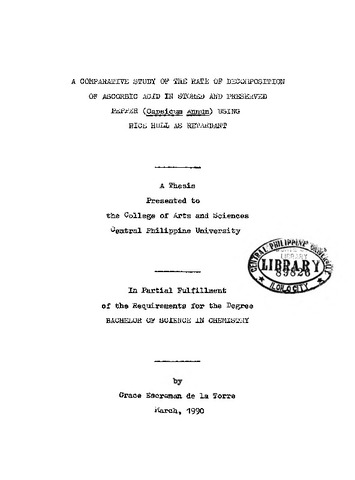
A comparative study of the rate of decomposition of ascorbic acid in stored and preserved pepper (Capsicum annum) using rice hull as retardant
Thumbnail
View/Open
Thesis introduction (134.0Kb)
Downloads: 49
Page views
775
Date
1990
Author
De la Torre, Grace Escraman
Thesis Adviser
San, Nympha Chan
Defense Panel Chair
Alba, Leda G.
Share 
 
Metadata
Show full item record

Abstract
Peppers are rich in vitamins especially vitamin C and minerals like calcium, phosphorus, iron and a pungent ingredient known as capsaicin. Peppers are used as condiment and extensively in flavoring meats such as sausages and vegetable foods. Besides being food flavoring and vegetable foods, they are also powerful local irritants and heart stimulants.

Pepper plants are cultivated in cold places and grown like tomatoes. The fruits are harvested when mature green, since ripening continues after the picking of the fruits. The harvested fruits are stored for household consumption or transported to the market.

Peppers are shipped and transported to other parts of the country by bulk. Producers depended on bamboo baskets or “kaing” for packaging. This sometimes cause spoilage of peppers, since pressure on handling and temperature change cannot be avoided.

During storage, peppers gradually rot or decay; some of its components are lost or just decrease- Such components are protein, volatile oils, capsaicin and ascorbic acid.6

The ascorbic acid content of pepper reduces when peppers are beginning to show spoilage, since ascorbic acid easily oxidizes. The spoilage of peppers is attributed to sudden temperature rise and oxygen accumulation. Oxygen activates the ascorbic acid oxidase, which is responsible for the reduction and total loss of ascorbic acid. Ascorbic acid oxidase is a copper—protein complex, and ascorbic acid deteriorates rapidly in the presence of traces of copper catalyst.

Object of the Study

The purpose of the study is to investigate the maximum storage life of peppers and also to determine how the storage of peppers using rice hull as retardant, affects the ascorbic acid content of pepper.
Description
Introduction and objectives
URI
https://hdl.handle.net/20.500.12852/1446
Suggested Citation
De la Torre, G. E. (1990). A comparative study of the rate of decomposition of ascorbic acid in stored and preserved pepper (Capsicum annum) using rice hull as retardant (Unpublished thesis). Central Philippine University, Jaro, Iloilo City.
Type
Thesis
Subject(s)
Peppers OCLC - FAST (Faceted Application of Subject Terminology); Peppers--Storage OCLC - FAST (Faceted Application of Subject Terminology); Vitamin C OCLC - FAST (Faceted Application of Subject Terminology); Plant nutrients OCLC - FAST (Faceted Application of Subject Terminology); Decomposition (Chemistry) OCLC - FAST (Faceted Application of Subject Terminology)
Keywords
Capsicum annuum GBIF
Department
College of Arts and Sciences
Degree
Bachelor of Science in Chemistry
Shelf Location
GSL Theses 540.72 D375
Physical Description
37 leaves
Collections
  • Bachelor of Science in Chemistry [11]

Contact Us | Send Feedback | https://creativecommons.org/licenses/by/4.0/ Logo by HLL
Central Philippine University © 2025
Managed by 
Henry Luce III LibraryHenry Luce III Library


Links
BAHÁNDÌAN Repository GuideDisclaimerFAQsSubmit your workNews and Updates

Browse

All of BAHÁNDÌANCommunities & CollectionsBy Issue DateAuthorsTitlesSubjectsThis CollectionBy Issue DateAuthorsTitlesSubjects

My Account

LoginRegister

Statistics

View Usage Statistics
CPU Henry Luce III Library

Contact Us | Send Feedback | https://creativecommons.org/licenses/by/4.0/ Logo by HLL
Central Philippine University © 2025
Managed by 
Henry Luce III LibraryHenry Luce III Library


EXTERNAL LINKS DISCLAIMER

This link is being provided as a convenience and for informational purposes only. Central Philippine University bears no responsibility for the accuracy, legality or content of the external site or for that of subsequent links. Contact the external site for answers to questions regarding its content.

If you come across any external links that don't work, we would be grateful if you could report them to the repository administrators.

Click DOWNLOAD to open/view the file. Chat Bertha to inform us in case the link we provided don't work.

Download