

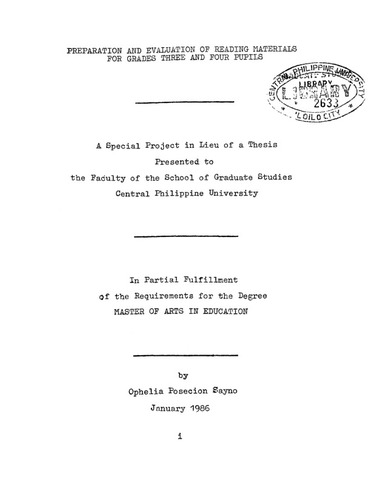
Preparation and evaluation of reading materials for grades three and four pupils
요약
Reading has long been recognized as an essential tool of learning and one of the most important activities in school and in our modern life. It cannot he denied that a pupil must be able to read in order to learn. His success in school and in today's world depends to a great extent on his reading proficiency.
Teachers seek to develop sequentially and gradually pupils’ basic reading habits and skills in learning to read in the primary grades, and work for the improvement of these habits and skills in the intermediate grades. A pupil who fails to learn to read well will be greatly handicapped by his poor reading ability as he gets older. According to Harris, the teacher of reading wants his' pupils to be able to read, to use reading effectively as a learning tool, and to enjoy and appreciate reading.
Reading is not one skill but a large number of interrelated skills which develop gradually over a period of many years. It is not mere recognition of printed symbols, but it is putting meaning to the facts and ideas presented and making reactions to them in the light of one's previous knowledge arid experiences.
Reading is a composite of skills and a complex process. Cognizant of the nature of reading, teachers strive to develop pupils' basic habits, abilities, skills and interests through effective reading instruction. The effective teaching of reading calls for the use of a wide variety of reading materials which are short and easy and a gradual moving towards more difficult and longer materials as pupils gain proficiency in the use of acquired reading skills. Durrel claimed that the use of a wide variety of instructional materials that are easily understood by the learner can be most helpful in the improvement of reading skills. If he understands what he reads, he will be more interested, will read more rapidly, will retain it better, and will be less frustrated.
The policy of "return to the basics" was adopted by our educational system in order to put renewed emphasis on the teaching of the 3 R's, particularly reading. The "no-read-no- move" policy which is being implemented in the public schools aims to develop and produce pupils who are proficient and skillful readers.
However, the lack of varied and appropriate instructional materials in our schools is one major constraint that hinders well-meaning teachers and school officials from making reading instruction highly effective. There is inadequacy of reading materials for the reinforcement of reading skills already acquired, and for enrichment activities. There is a need for reading materials which are suited to those pupils who are ready for independent reading.
Aware of these problems that beset teachers in the field and imbued with the desire to help improve the teaching of reading and, consequently, the reading performance of pupils, the investigator attempted a project to help solve these problems in the field.
The Problem
The primary aim of this project was to prepare and evaluate reading materials for two consecutive grades, three and four, intended to develop vocabulary, proficiency in word- attack, and comprehension skills on three dimensional levels, namely, literal, interpretive and critical. The specific outcomes that are to be realized were taken from the Elementary Learning Continuum prescribed by the Ministry of Education and Culture and from Barbe's "Reading Skills Checklist Sequential Skill Plan."
The evaluation of the project will take the form of determining the validity, reliability, and usability of the reading materials for the target grades.
기술
Introduction and statement of the problem
추천 인용
Sayno, O. P. (1986). Preparation and evaluation of reading materials for grades three and four pupils (Unpublished Master’s special paper). Central Philippine University, Jaro, Iloilo City.
유형
Special paper주제

학과
School of Graduate Studies정도
Master of Arts in Education with specialization in Reading (English)선반 위치
GSL Theses 378.242 Sa99
물리적 설명
184 leaves