

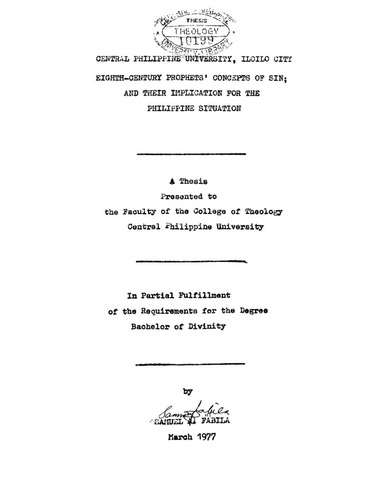
Eighth-century prophets’ concepts of sin; and their implication for the Philippine situation
요약
This thesis deals with the topic, "The Eighth-Century Prophets’ Concepts of Sin and their Implication for the Philippine Situation." It is an historical and Biblical study of the term "sin" as found in the concepts of Amos, Hosea, Micah, and Isaiah, and attempts to get an implication for the present Philippine situation.
The aim of the first major topic is to find a definition of sin. An attempt was made to get a secular definition of sin. Old Testament background was also consulted, from the Early Narratives down to the Sinaitic Laws. The use of the term was also considered.
Sin in man’s relation to God is rebellion rather than transgression. According to the author’s study one can transgress any ethical laws without being religious and without sinning. But rebellion implies sin, for it con- notes one’s relationship with God, to whom he is unfaithful.
The second major topic deals with the Eighth-Century Prophets’ Concepts of Sin. It is the center of the work, for it aims to discuss the central purpose and heart of the work. One’s relationship to God is equated with his relationship to his fellowmen. Amos sees sins against God in the avarice, injustices, immorality, superficial and hollow worship of the people. To him, religion has to touch politics and purses. Together with him was Hosea, who went on to condemn the disloyalty of the people to Yahweh; he scorned the unfaithfulness of the people to their God in every sphere of life. He summoned them to return to God in sincere and deep repentance.
Isaiah, like Amos, attacks the idolatrous, shallow worship of the people, their luxurious living, their in- justice and oppression of the righteous. He urges the people to repent and to restore faith and quiet confidence in God. Micah joins with him in this attack on luxurious living at the expense of the poor, and summons the people to execute justice and love toward God. People have rebelled and sinned against God, because they have destroyed their right relation to other people.
The third major topic deals with the implication of the Eighth-Century prophet’s concepts of sin to life in contemporary Philippines. Christianity has its roots in the Old Testament; it is therefore proper and helpful that before exploring New Testament ideas one must study the corresponding Old Testament ideas. A Filipino is not only a Christian in the church, but he is also in the midst of a political and economic situation, and even living in a time of social unrest. His faith and obedience to God can be shown through his involvement in the ongoing activities and situation of the country. Like the prophets, a Filipino is summoned to do his duty toward his fellowmen as his duty toward his God.
This study leads us to the conclusion that sin is not only meant in the cultic sense of the word but in an ethical and moral sense as well. This will further help us in the making of our message on sin more specific by pointing out exactly where in this kind of world one sins.
기술
Abstract only
추천 인용
Fabila, S. A. (1977). Eighth-century prophets’ concepts of sin; and their implication for the Philippine situation (Unpublished thesis). Central Philippine University, Jaro, Iloilo City.
유형
Thesis
키워드
학과
College of Theology정도
Bachelor of Divinity선반 위치
TheoLib Theses 207.2 F112
물리적 설명
viii, 68 leaves