

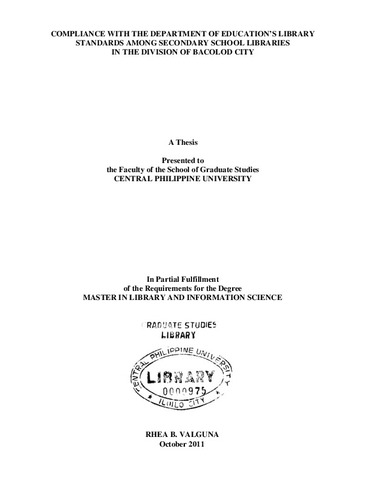
Compliance with the Department of Education’s library standards among secondary school libraries in the division of Bacolod City
Abstract
This study was conducted to determine the level of compliance of all secondary schools in Bacolod City based on the Department of Education’s Library Minimum Standards. The respondents were the 23 private and 22 public secondary schools in the Division of Bacolod City. Data gathering was conducted from December 21, 2010 to February 8, 2011. This descriptive-evaluative survey method was conducted using a two-phase survey questionnaire in collecting data. The phase 1 questionnaire was self-made by the researcher and was approved by the panelists. The phase 2 questionnaire was patterned from the Minimum Library Standards given by the Department of Education. Random confirmatory interviews were also conducted to follow-up on data submitted and to clarify questions. This one-shot survey gives more attention in obtaining information concerning the current status of the phenomena to describe “what exists” with respect to variables or conditions in a given situation.
There are 23 private and 22 private secondary schools in the city with one earliest established school coming from the private sector as early as in the 1930’s. Four schools (17.39 percent) were added to the private sector from 1940 to 1949, while the earliest public school in the city was established from 1950 to 1959. Four more private schools (17.39 percent) were established from 1960 to 1969 while 5 public schools (17.39 percent) were added to the public secondary school sector. From 1970 to 1979, three more private and public schools respectively were added to the list. From 1980 to 1989, eight more private schools (26.09 percent) were established, while two public schools (9.09 percent) were added. From 1990 to 1999, seven public secondary schools were added to the growing number of public schools and from 2000 to 2011, two more private schools and four more public schools completed the list of secondary schools in the city.
Public schools are more populous than private schools, with the highest population ranging from 4000 to 4999. The lowest population comes from the private school sector with as little as twenty eight high school student enrollees for the school year. Of the twenty three private school respondents, twenty two schools, comprising 95.65 percent have a population of less than a thousand while one private school’s population that ranges from 1000 to 1999. There are also three public schools with a population range of 2000 to 2999, one private school with a population range of 3000 to 3999 and another public school with a population range of 4000 to 4999.
Major Findings of the Study
The private schools are further subdivided into three types - the sectarian group comprising ten Catholic schools, ten Christian Schools and three schools, though private, are not sectarian at all.
Private schools are also categorized to according to their accreditation status. There were seven PAASCU accredited institutions, two ACSCUAAI accredited institution, six FAPE accredited schools and 8 smaller private schools which do not belong to any accreditation group.
Results of Table 3 shows that out of the 23 private school respondents, sixteen schools (69.47 percent) have fully complied with the room area standard, seven private schools (30.43 percent) did not meet the room area requirement. All twenty public school respondents (100 percent) have zero compliance with the minimum room area requirement of the DepEd.
Results of Table 3a shows that private secondary school libraries have met most of the minimum requirement in terms of the number of units in the physical facilities. PAASCU and ACSCUAAI accredited schools have mostly exceeded the required number of units in the standard while the FAPE accredited schools have also met the minimum required units. There are public schools that have met the minimum requirements but all these public schools have zero compliance in terms of the salient furniture needed in operating a library such as circulation desks, card catalog , shelflist and index card cabinets, storage cabinets, bulletin boards, book trucks, typewriters, cassette and video players.
Table 3b shows that both private and public and public schools did not have 100% compliance in the following library furniture measurements: armless chairs, charging/circulation desks, sunken bay, dictionary and atlas stands, librarians’ tables, librarians’ chairs and book trucks. Though these libraries are equipped with the required furniture, the respondents mostly fail in the expected furniture measurements.
Table 4 shows that the private school libraries almost have all the library resources required in the standards except for the librarians tools of which the result varies in percentage for compliance and non-compliance. Public schools’ noncompliance to the acquisition of library resources is of bigger percentage compared with the percentage of their compliance. Public schools have zero compliance in terms of the acquisition of librarians’ tools. These schools do not have a well defined library budget and the composition of their library collection is very dependent on the donation they receive since results show that both respondents’ schools have 100% compliance in terms of donations.
In the Organization and Maintenance of Library Holdings, the private institutions have a 100 percent compliance compared with that of the public schools that have zero compliance in all three provisions.
In terms with the teacher-librarian ratio to students’ population, the private schools fare well than the public schools which have zero compliance in all the four population brackets.
There are more registered/professional librarians in the private schools, some of which have master’s degree in library science. Of the twenty public schools, only one school has a registered librarian, another school library is partly manned by a teacher-librarian with a minor in library science while twenty public schools have zero compliance in terms with the librarian’s professional degree requirement.
In terms with the library services, the private schools, especially those that have accredited status have fully complied with the required standards. These schools have professional librarians who perform library tasks such as library instructions, act as adviser of a Library Club, and assist students in the use of library resources and conducts library orientation to teachers and students at the start of the school year. Private school librarians have a higher percentage of attendance in seminars and workshops and since their libraries are open all the time during school hours, the facility serves as the information center of the school and the parents. Public schools on the other hand almost have zero compliance in all the eleven provisions stated in the standard under the services area. However, both private and public schools have 100% compliance in the participation in the National Book Week Celebration.
Description
Abstract only
Type
ThesisSubject(s)

Keywords

Department
School of Graduate StudiesDegree
Master in Library and Information ScienceShelf Location
GSL Theses 020.72 V238
Physical Description
xv, 156 leaves